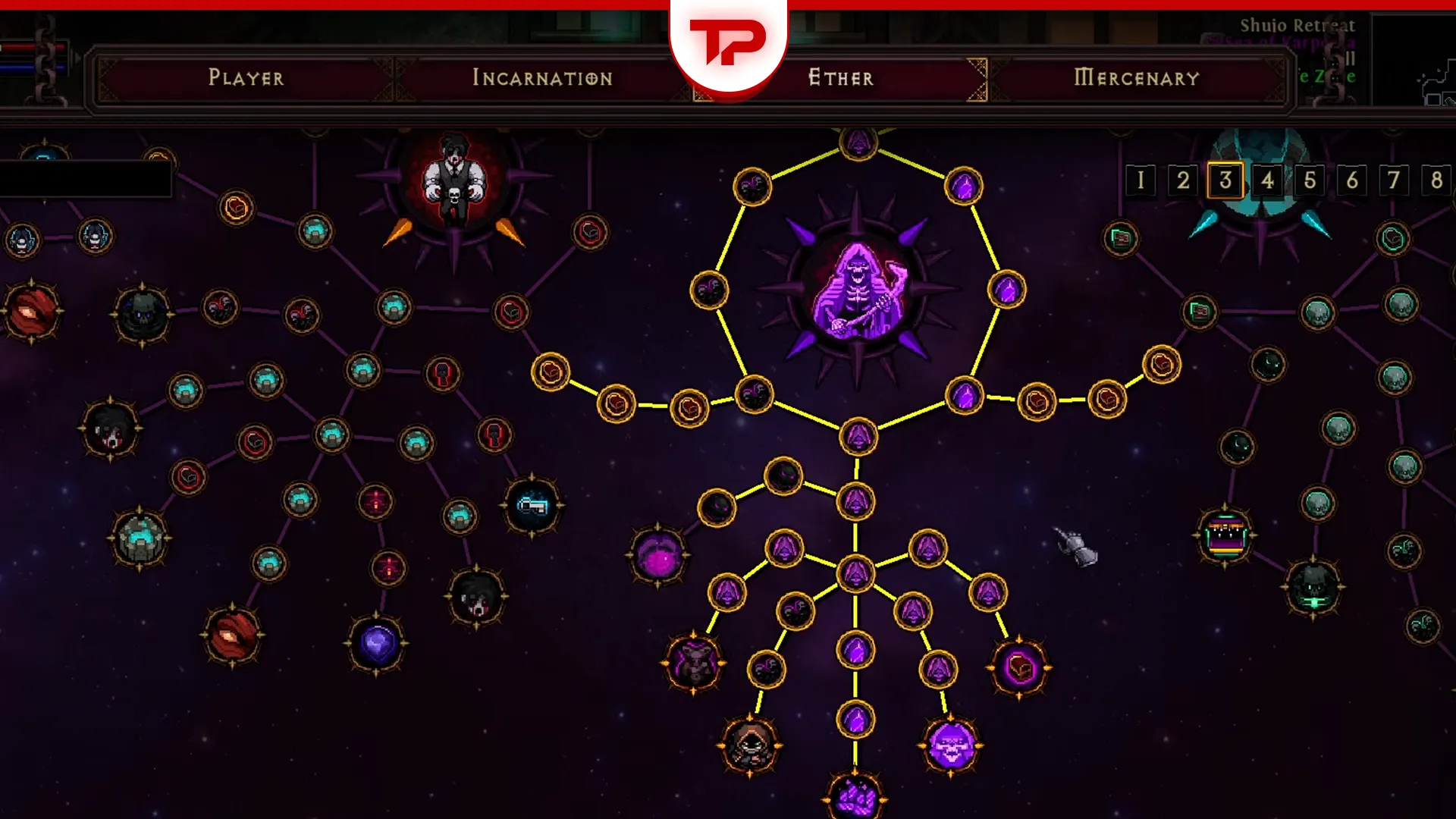


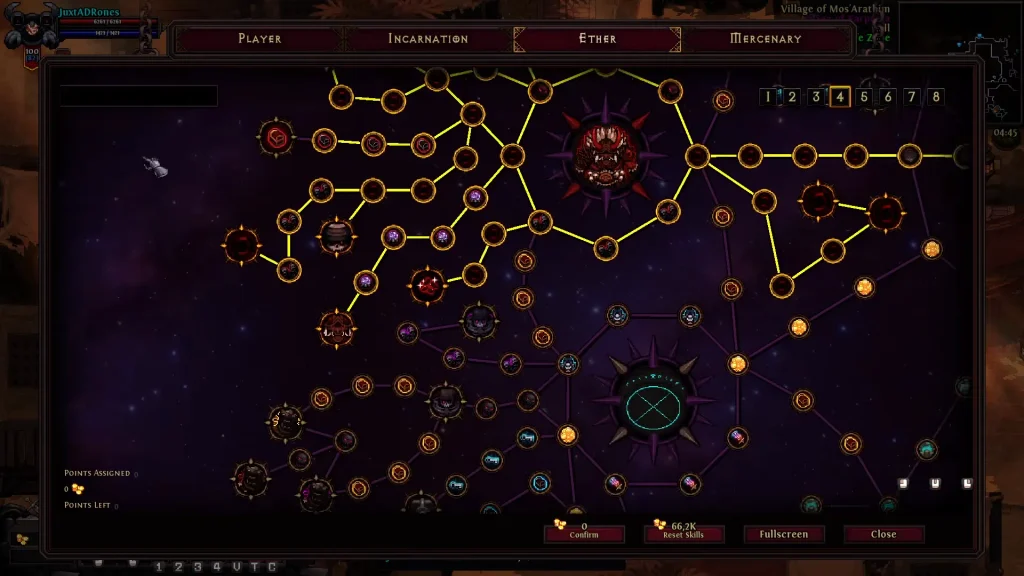
If you’ve hit the endgame in Hero Siege and started seeing quest markers pointing toward a tree that isn’t your class tree or the Incarnation Tree, you’ve found the Ether Tree.
It’s one of the two big systems Panic Art Studios added in Season 9 and by Season 10 it’s turned into the thing most farming builds actually revolve around. I mean mining and boss loops.
Table of Contents
What the Ether Tree Is
The Ether Tree is a mechanics tree, not a power tree. Panic Art Studios launched it alongside Season 9 on April 3, 2026, describing it in their own announcement as an “Atlas tree.”
The Ether Tree lets you reach into specific game mechanics and turn them up.
That’s the real difference between this and the Incarnation Tree. It trips people up constantly. If you’re after raw stats, the Incarnation Tree is what you want. If you’re trying to make a mechanic you already farm hit harder (better drops, faster runs, more currency per hour), that’s the Ether Tree’s job.
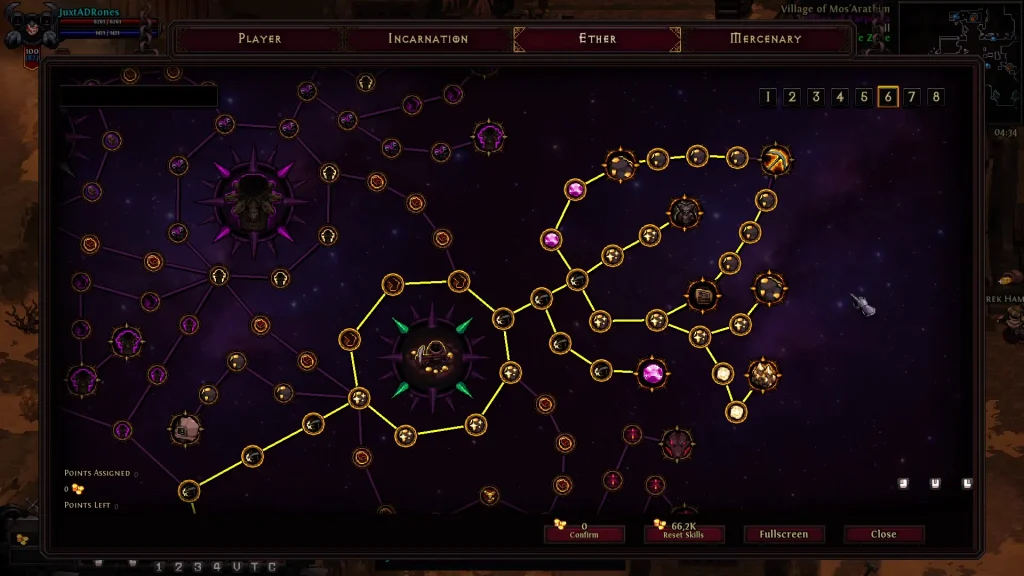
Size and Node Count of Ether Tree Hero Siege
The Hero Siege Ether Tree has 400+ nodes at launch and the Incarnation Tree at 1,600+ nodes.
Both trees grew in Season 10. The Ebontharn announcement lists over 100 new Ether nodes and over 600 new Incarnation nodes, which puts Incarnation somewhere north of 2,200 in its current state.
How to Get Ether Points Hero Siege
Ether points come from special quests that appear on their own and complete automatically. These quests show up across the various Hell difficulties and eventually in Inferno.
The tree opens at level 100 and the first batch of points lands when you reach 100 and create your first Hell game. You’ll hear a sound cue and a stack of orange quest markers will pop. Progressing deeper into Hell (particularly the questlines leading toward the Uber bosses) opens further chains you can then pick up in Inferno.
Nine points do not get you far. Most of the builds below need meaningfully more than that before they start paying off. Therefore, expect an early stretch where the tree looks disappointingly empty. That’s normal, not a bug.
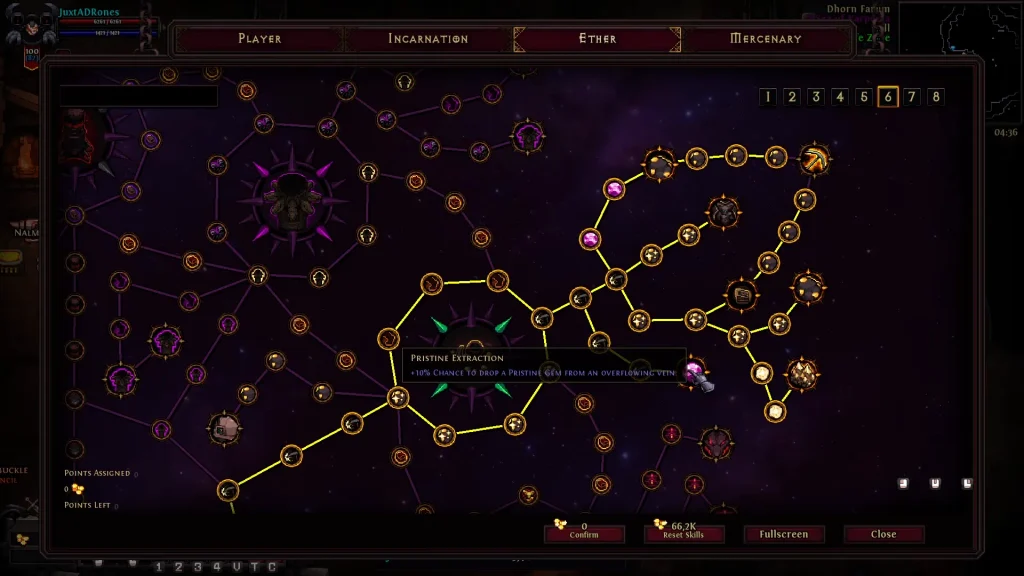
Season 10 also made one change that matters for everyone. You can now hit a 100% spawn rate for any mechanic by fully investing in its Increased Spawn Rate nodes. Combined with each mechanic’s base spawn chance, that guarantees the mechanic will appear.
How to Reset Your Ether Tree Points
You can’t just move a point mid-run. Ether Tree changes require a Vote Reset. You can’t reallocate nodes while you’re actively in a map or fighting monsters.
To adjust your build, back out to town (or the menu) and trigger a Vote Reset, which costs gold per node you want to move.
Season 10 lowered this cost from 1,750 gold per node down to 1,250 gold per node. It is good news if you like to switch between, say, Mining and Chaos Tower depending on what you need that session.
Ether Tree and Incarnation Tree Comparison
| Category | Incarnation Tree | Ether Tree |
|---|---|---|
| Unlocks | Level 100 | Level 100 (points begin upon entering Hell) |
| How to Earn Points | Hero levels, with no cap past the soft cap | Auto-completing quests in Hell and Inferno |
| What It Affects | Character power and passive stats | Game mechanics, including loot, farming, and endgame systems |
| Node Count | 1,600+ at launch; +600 in Season 10 | 400+ at launch; +100 in Season 10 |
| Loadouts | Up to 8 saved loadouts | Up to 8 saved loadouts |
Hero Siege Ether Tree: Best Builds in Season 10
There isn’t a single “best” Ether Tree. Most experienced players will tell you the same thing: pick the mechanic you actually enjoy farming, because a build that makes more currency per hour on paper won’t matter if you’re bored enough to quit before you use it.
With that said, a few trees have emerged as the go-to options this season, and most of them noticeably outperform on Inferno compared to Hell.
Mining Tree: Currency With Almost No Gear Required
This is the build people recommend when you’re undergeared or just don’t want to fight anything. It works at any difficulty and doesn’t require good gear because it doesn’t require combat at all. You’re just running around mining ore veins, which also happens to be a solid movement-speed boost while you do it.
One Season 10 change to plan around: Ore Goblins now only spawn from mining nodes if you’ve specced into that node. They no longer appear naturally, so if goblins were part of your mining income, that’s a required investment now.
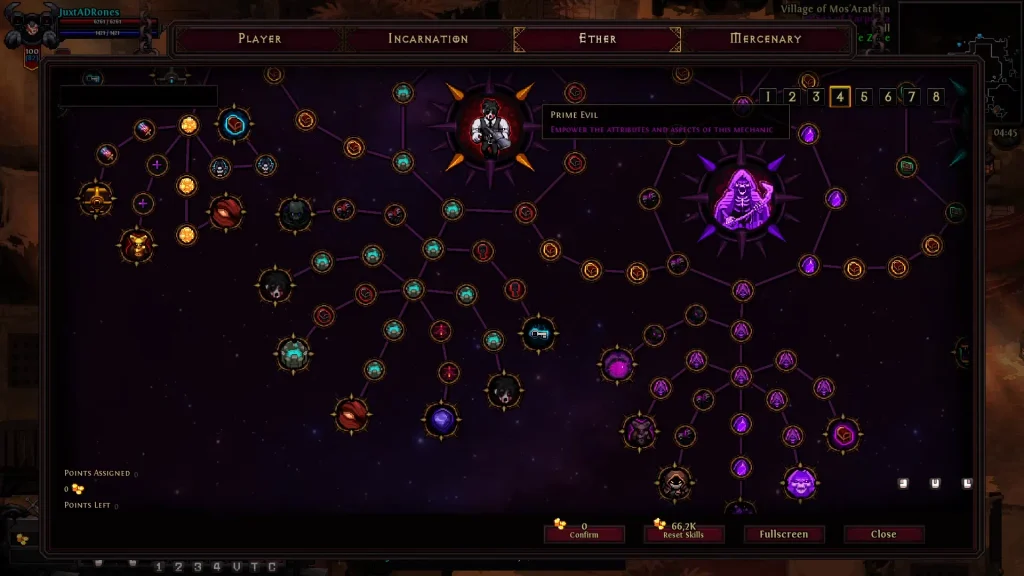
The ore itself is directly sellable on the market without any extra crafting.
Overworld Bloating Tree: the Fastest Leveling Route
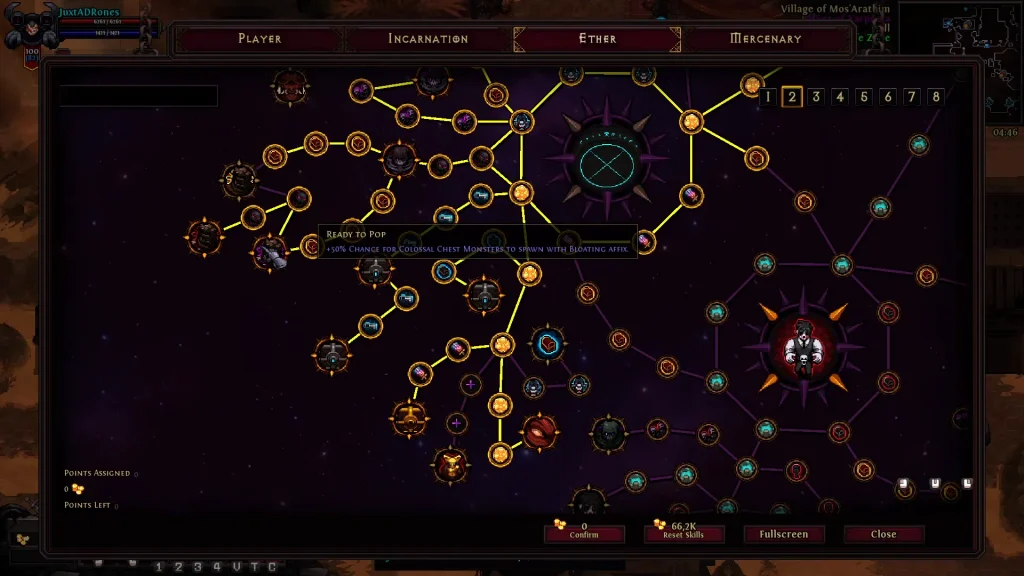
This one is built entirely around a leveling strategy that got popular this season: hunting down colossal chest events and the “bloating” monster packs that spawn around them.
Once it’s set up, you look for the specific building tied to a colossal chest event. Misty Swamp is a commonly cited spot, and it also appears in King’s Garden, a specific Pyramid level and a prison dungeon. Trigger the event and you get swarmed with bloating monster variants that die fast and drop a large amount of experience.
Further investment can push the event to spawn as an “unstable rift” version instead of the normal one, which carries the same bloater bonus plus an additional experience and magic find bonus on top. With Season 10’s guaranteed-spawn change, that’s reliably reachable rather than a coin flip.
One caveat: the Unstable Rift “Warped Fortune” node no longer works in rift zones.
Boss Trees: Reaper, Sung Lee, and Damien (Prime Evil)
There are three boss-farming trees worth considering and picking between them mostly comes down to whether you want items or currency.
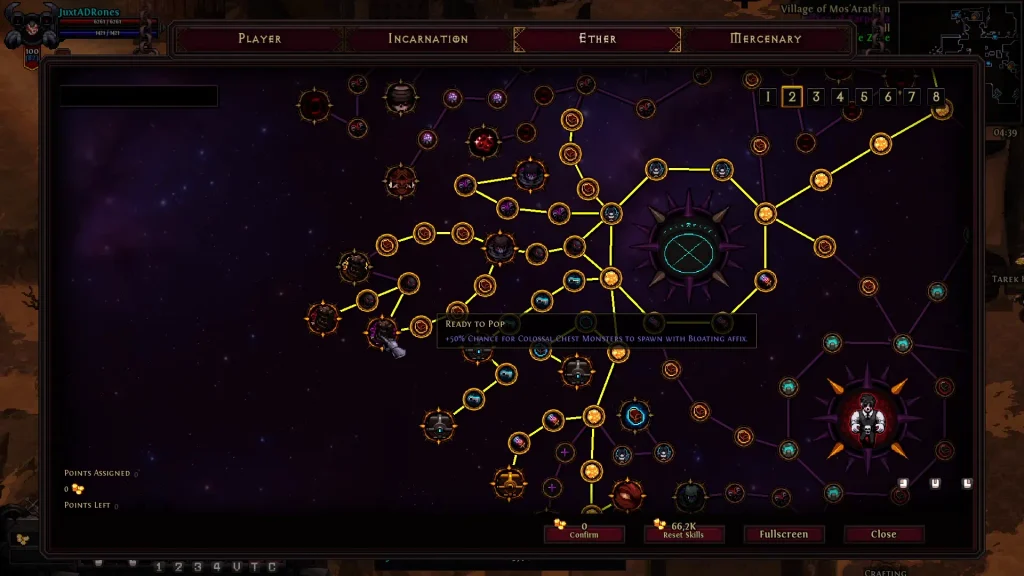
Reaper is generally considered the best source of valuable items early on, especially once you invest in nodes that let you fight two Reapers at once (as long as you can actually kill both). A high-value node also increases the chance of a Reaper encounter spawning naturally while you’re out farming maps.
Damien, farmed through what players call the Prime Evil side of the tree, tends to be the most profitable option in pure currency terms. Key nodes give a chance for an act boss to respawn without you having to track him down again, a chance to drop a Key of Terror outright (the item that gates entry to Fallen Inoya, where Fallen Damien lives) and better monster rarity in the dungeons leading up to the fight. His unique drop materials have reportedly sold for tens of thousands of gold each.
Sung Lee is the least recommended of the three on Hell difficulty though it reportedly improves once you’re farming him on Inferno.
Pillar Tree: Relics and Boss Materials
Built around the game’s pillar mechanic, this tree focuses on boosting pillar spawn rates and the value of what they drop, with an emphasis on relic-related nodes since relics have been in short supply this season. Shrine and unique-chance nodes tied to pillars are considered strong picks; total Magic Find nodes in this section are treated as low-priority filler.
Season 10 rebalanced what pillars drop and it’s worth knowing before you commit. Chaos Key drop chances were cut by 50%, but pillars gained several new drops by rarity tier. Destiny Shards on Rare+, Gypsy’s Prophecies on Mythic+ at nightmare and above, Prophet’s Wisdoms on Satanic+ and Satanic Dice on Angelic+ at hell and above.
Shrine nodes can roll Destruction Shrines alongside Chaos Shrines, which is where the valuable ruby chest and scroll rewards come from.
Unholy Siege + Relic Hybrid Tree
This build focuses on the Unholy Siege mechanic, which isn’t worth engaging with at all until you’ve filled out its core nodes, discovery range, spawn-chance nodes for the event itself, and pack-size boosts for the monster waves it spawns.
Past that threshold, it turns into a genuinely strong loot event. It pairs well with relic-zone farming, since it gives you something productive to do while waiting on relic spawns.
There’s a real risk/reward node in this tree that adds extra monster affixes for more loot. More affixes also means nastier monster combinations. So it’s generally recommended only if your character can already tank or avoid heavy damage.
Chaos Tower: Minimal Investment, Pure Blasting
This is close to the simplest tree on the list.
You run to the tower and kill everything that spawns. There isn’t much else to build around it. Season 10 rebuilt monster pathfinding from scratch across the whole game. Monsters are now more aggressive, path more directly and no longer get stuck on geometry. That’s a global change rather than a Chaos Tower one, but this farm benefits from it more than most, since the entire loop is “stand somewhere and let things come to you.” Leftover points typically just go into Magic Find nodes.
Eternal Battlefield: The All-Rounder
One of my favorites because of how repeatable it is. Leave the battlefield zone, walk back in and a large wave of monsters spawns again. Most of the tree’s value comes from taking every node that boosts monster count and movement speed inside the zone.
Two Season 10 adjustments here pull in opposite directions. Blitzkrieg was buffed from 2% per point to 8%, while The Key to Battle was nerfed from 1% to 0.10%. It is a 90% cut that makes it a much weaker pick.
Bifrost / Vanaheim: Advanced Endgame Loop
A more specialized, Inferno-focused tree built around farming access to Vanaheim through the Bifrost mechanic. I can describe it as stacking the same boss-encounter nodes used in the Reaper, Sung Lee, and Damien trees simultaneously, since the goal isn’t any single boss. It’s chaining Uber Boss, Ruby Garden and Vanaheim access together as a repeating endgame loop.
Hero Siege Ether Tree: Tips for New or Lower-Difficulty Players
Season 10 overhauled progression. Normal is now the only playthrough where you push through the acts. Once you finish it, Normal transitions into Nightmare and you keep all your waypoints.
If you’re there and feel locked out of all this, you’re not entirely out of options. The pillar mechanic is strong even with minimal node investment, since a small early cluster gets you a high pillar spawn rate and pillars can drop relics and unique items regardless of your gear level.
The overworld bloating leveling route also works in Nightmare, just less efficiently than in Hell.
One frequently repeated solo tip I use frequently: gear your mercenary with some survivability and a single point in its taunt ability so it can hold the tougher monsters while you clear and reset the event.
Should You Rush the Ether Tree Early?
Not really and the way points are gated makes that decision for you anyway. Get your class online through its regular skill trees and the Incarnation Tree first, then start picking up Ether points naturally as you push into Hell and Inferno.
If your Ether Tree looks mostly empty shortly after level 100, that’s not a bug. You have just got your starting allocation and haven’t hit the difficulty tiers where the rest of the points live.