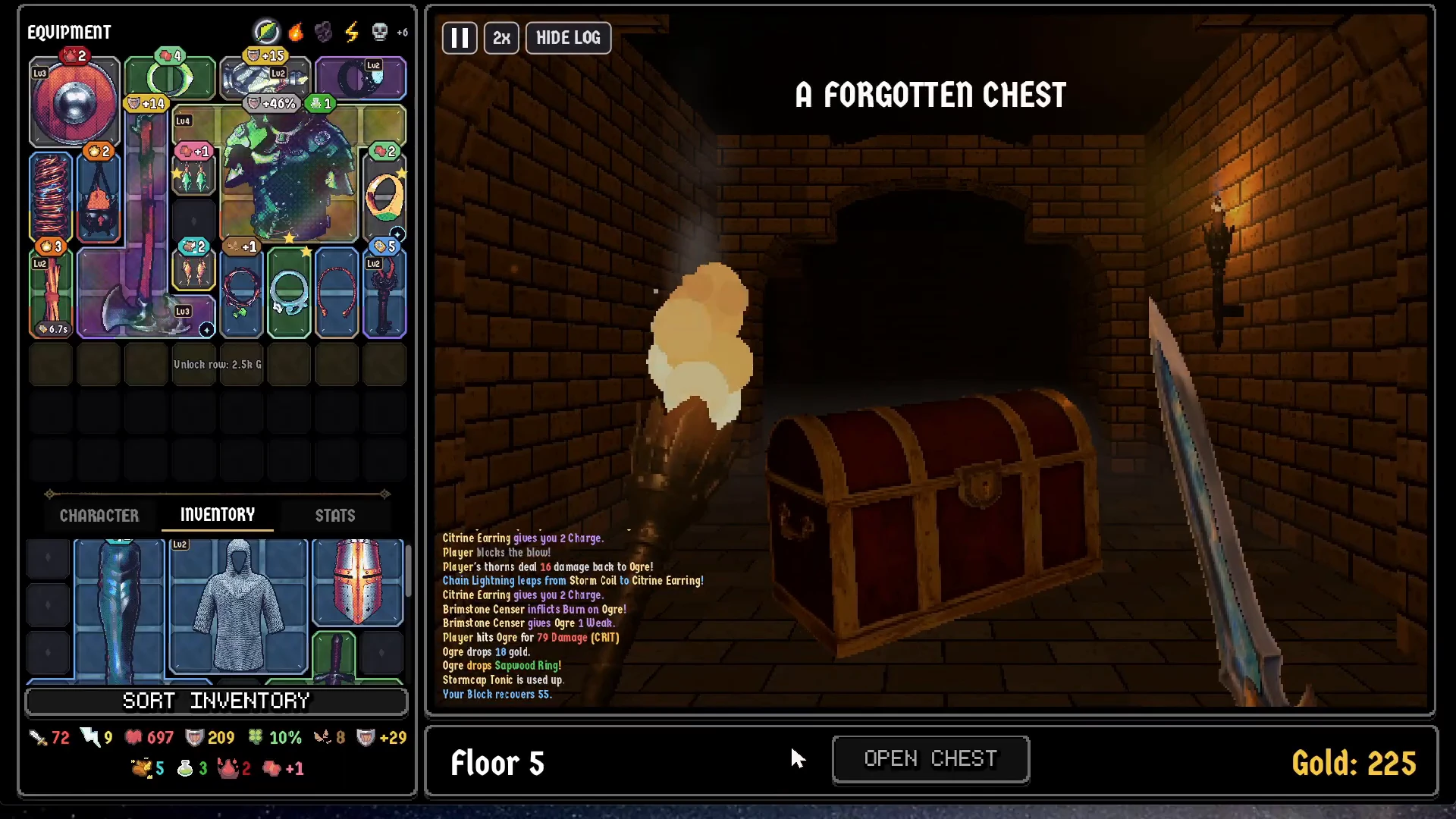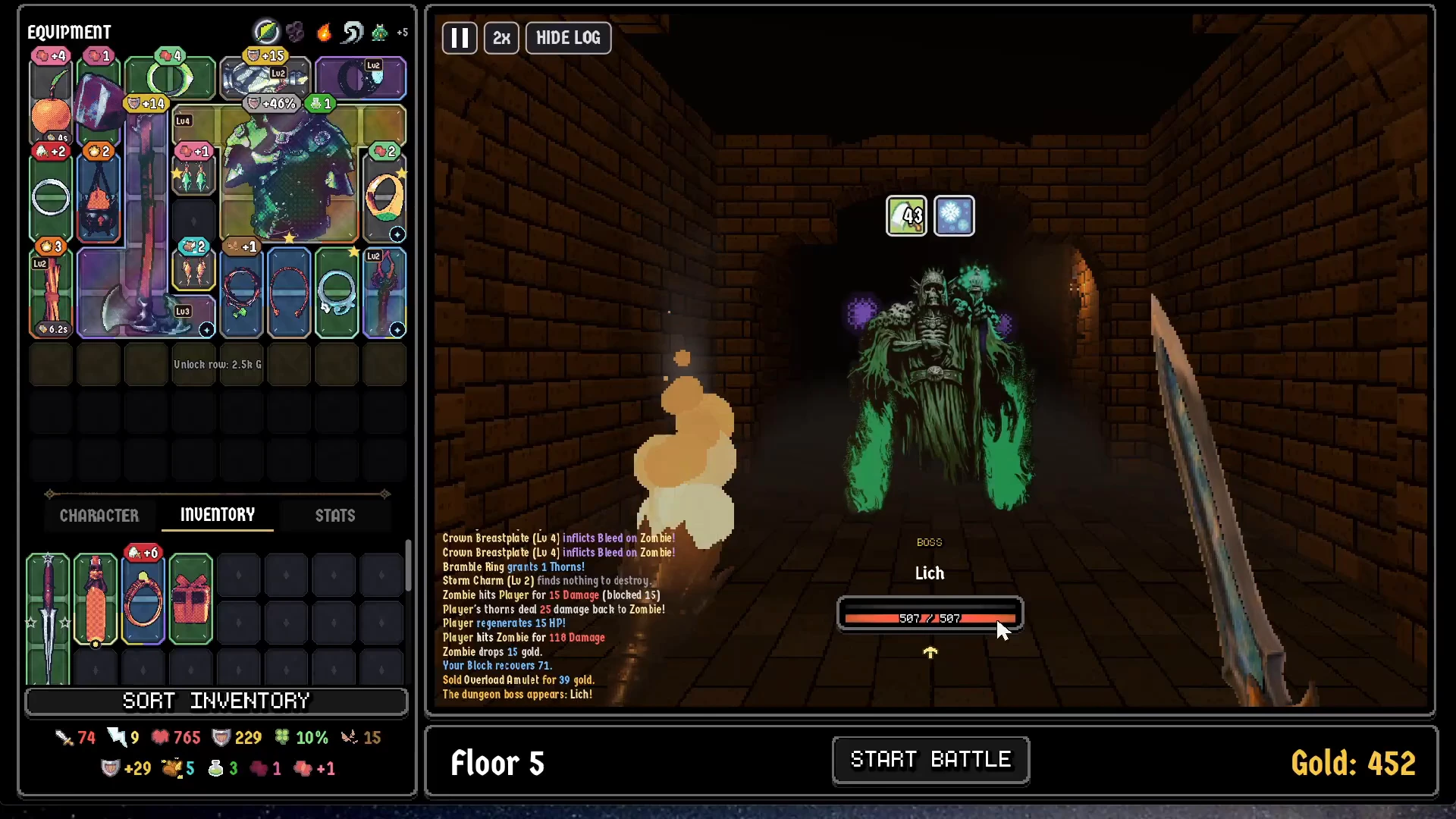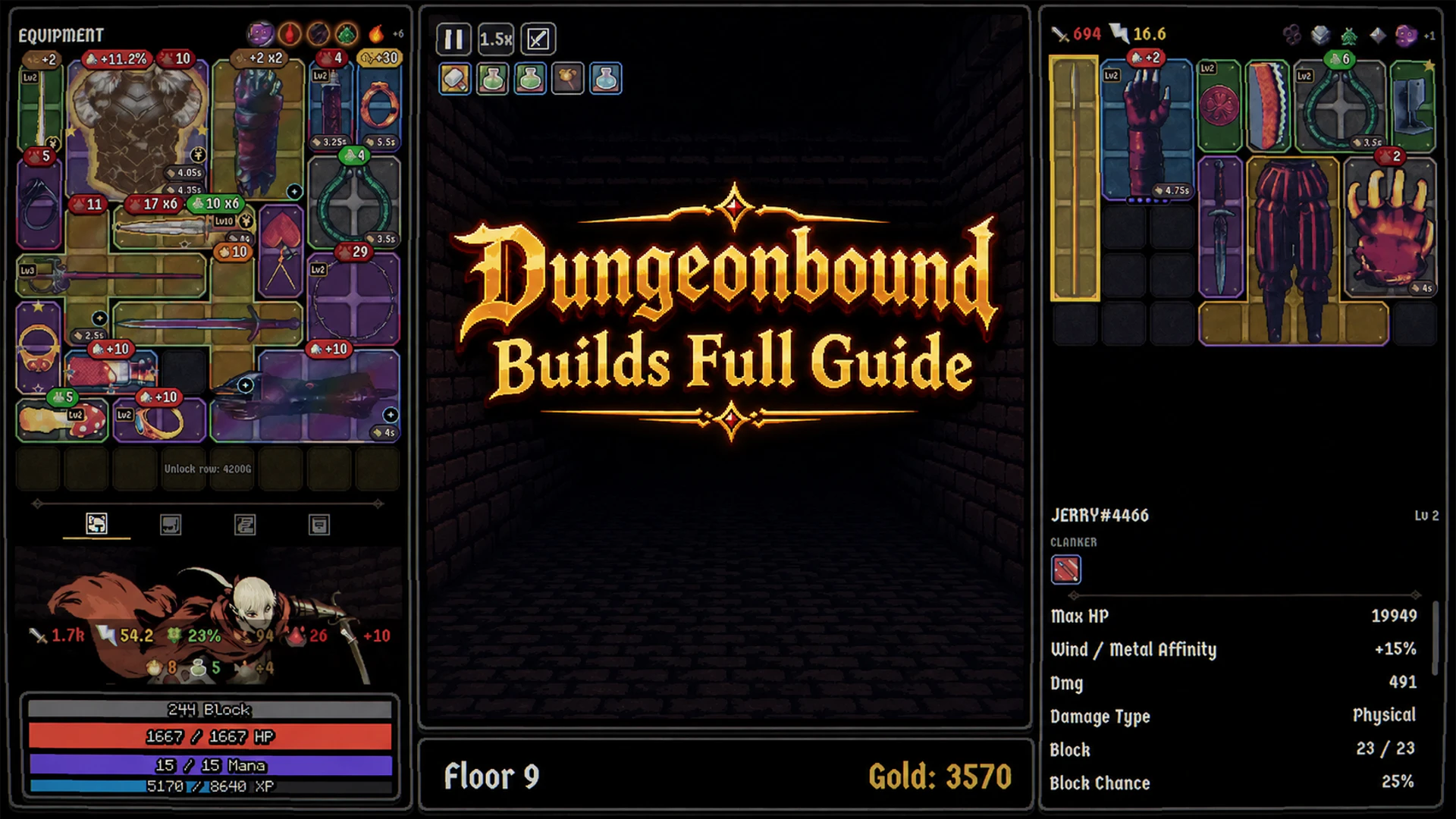


You could think up the best Dungeonbound build ever and still get smashed in the first serious fight you get into. That’s because your weapons don’t do all the work. The way your equipment synergize and interact with one another matters just as much as the damage numbers you on your weapons. Your items can either trigger on attacks or timers, and then there’s the fact that they can improve their neighboring items. If you’re still getting used to the equipment board, my Dungeonbound guide covers the basics of runes, forges, and combat. Get familiar with the game’s mechanics before you commit to a specific build.
There isn’t one single best build for every run, as you can guess. Squire’s Shortsword gives you really powerful foundation for your physical melee heroes, while Bleed and Poison can deal damage through Block. Paladin offers a more defensive approach, and Undead Thorns has its own use against Death.
Build your Build:
Which Dungeonbound Build Should You Try First?
Honestly it all depends on the hero you choose. You don’t to find every equipemt known to man to create your build, but still you should put extra focus on some core equipment. Each build offers its own main advantage too. Check out the table below for the exact info:
| Build | Core Equipment | Main Advantage |
|---|---|---|
| Starter Sword | Squire’s Shortsword with another triggered sword | Repeated weapon triggers |
| Bleed/Vampiric | Hemomancer’s Charm, Bleed equipment | Bleed rupture and Lifesteal |
| Paladin Holy/Metal | Oathbound Locket, Holy weapons | Healing and Smite |
| Poison | Adder Ring, Viper Gland | Damage through Block |
| Undead Thorns | Rattling Greaves, Undead gear | Thorns damage against Death |
| Black Knight Burn | Fire/Demon equipment | Burn application |
| Valkyrie Lightning | Lightning gear, Multi Trigger | Repeated item effects |
| Ashigaru Spear | Ashigaru Yari, spear equipment | Spear stat scaling |
Best Starter Sword Build for Solo Climb: Squire’s Shortsword

If you’re the type of player who likes going it solo, you probably start out with a physical-based (melee) hero. Squire’s Shortsword will surely come in handy for you. gives +4 Damage and a 5-damage activation every 3.25 seconds. But the best thing about it is that it also triggers one additional time when another sword triggers. Instead of filling the board with random weapons, give Squire’s Shortsword a second sword that has an actual trigger. A sword that only adds passive Damage won’t do the trick though.
And then there’s also the Brotherhood Blade. At the beginning of every fight, it grants every other sword +1 Multicast for that battle. It’s an amplifier rather than a requirement, so don’t go spending your entire budget trying to find it.
Keep some defense while your swords scale. Don’t fill your equipment grid with swords. You still need some defensive fallback. Studded Targe, for example, gives you a +24 Block and a +18 Thorns. Every 6.25 seconds, it also gains +1 Block and +1 Thorns for the current run. STUDDED TARGE DOESN’T TURN BLOCK INTO DAMAGE.
Bleeder Build: Vampiric Bleed and Rupture
Might be my favorite build. Instead of just betting all your chips on direct hits, you try to stack Bleed on an enemy and use subsequent attacks to rupture them. When Bleed ruptures, all its stacks deal damage but then are cleared. Bleed rupture ignores Block, which makes this build extra, extra good against enemies with heavy armor.

Makken is a natural choice for a Vampiric Bleed build. His affinities are Vampiric and Undead and his starting relic, Blood Thirst, provides 15% Lifesteal. He also this other awesome item called Blood Fang Charm. It’s a small trinket that restores 2 HP and applies 1 Bleed every 4.75 seconds. This doesn’t mean you HAVE to use Makken for a bleed build, but I’m just saying that it’s the best hero for this build overall.
Best Items for a Bleed Build
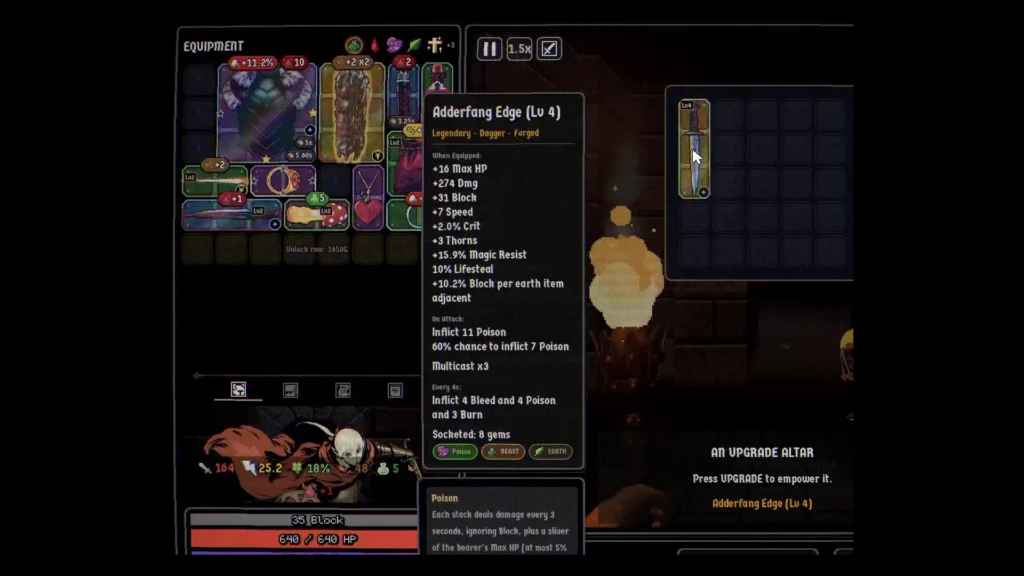
For a bleed (bleeder) build, naturally, you have to focus on creating opportunities that help with stacking the bleed effect. At the same time, you want anything that has to do with healing and lifesteal. Below, I’ve gathered all items that could help you out along the way if you’re determined to be a hardcore bleeder.
| Item | Effect | Build Purpose |
|---|---|---|
| Hemomancer’s Charm | Bleed application, additional Bleed damage and rupture bonus | Main damage amplifier |
| Bloodletter’s Signet | +30% Item Crit; applies 5 Bleed on attack | Bleed application |
| Hemorrhage Knife | +9 Damage, bonus Bleed damage and chance to apply stacks | Early weapon option |
| Razorwire Band | Bonus Bleed damage and chance to inflict 15 Bleed | Higher Bleed application |
| Bloodpump Pendant | Chance to apply Bleed, heals you when Bleed ruptures | Survivability |
| Reaper’s Scythe | Bleed application and Lifesteal | A useful weapon option |
| Bloodstone | Adds Bleed to item triggers | Gem support for bleed weapons |
| Adderfang Edge | Adds Bleed and Posion | Simultaneous gradual damage types that override Block |
Heromancer’s Charm is the top choice on the list because at only level 1, it gives you +1 Bleed damage per stack and +50% Bleed rupture damage. It also applies 4 Bleed at the beginning of the fight (battle start) and another 2 Bleed every 3.25 seconds. However, its real advantage is that it handles both application and amplification. That essentially means you don’t need to start using another item just to get your first Bleed stacks onto the enemy.
How to Make Bleed Rupture Work
A good bleed build needs many stacks and a way to make those stacks have an actual impact. Hemomancer’s Charm begins applying Bleed before your first ordinary attack, for instance. Attacks can then rupture the stacks you gathered throughout the fight, while the charm’s timer supplies more Bleed as the battle continues. This is exactly why I’d favor a steady attack pattern over a build that has plenty of Bleed items, but then hardly any actually-worthwhile hits.
Don’t confuse Attack Speed with item cooldowns, though. Speed affects your hero’s attack frequency, which can create more opportunities for On Attack effects and Bleed ruptures. Also, make good use of Bloodstones. A common Bloodstone can inflict 1 Bleed through an item’s trigger. If the item has no trigger, then the gem can add an On Attack Bleed effect. Any Bloodstone of higher quality will provide more stacks.
Vampiric Set Bonuses and Survivability
This is perhaps the most vital and advanced section of the bleed build because it provides the defensive aspect of the build. It gives you a good deal of Lifesteal. If you’re still early in your run, I’d suggest you aim for four Vampiric pieces before trying to reach six or eight. Here’s every bonus the Vampiric Pieces provide anyway:
| Vampiric Pieces | Damage Bonus | Lifesteal |
|---|---|---|
| 4 | +2 Damage, +5% Base Damage | +10% |
| 6 | +4 Damage, +10% Base Damage | +20% |
| 8 | +6 Damage, +15% Base Damage | +30% |
How to Counter a Bleed Build
Easier than you’d think. Purifying Aegis, for example, can remove debuff stacks when its timer goes off. Moonlight Cleaver provides status immunity while below half HP, although that immunity affects beneficial statuses too. Reflect can also send incoming debuffs back to their source. Even a strong rupture setup you came up with your big brain can struggle if the opponent kills you before your status effects have time to go off.
Paladin Build: Holy Healing and Metal Defense

If you want to go for a build that focuses on healing and defensive equipment, Paladin is right down your alley. The Paladin’s affinities are Holy and Metal, and his starting Oathbound Locket shares the same affinities. Healing Tincture, the Paladin’s other starting item, grants 3 Regen per Climb level at battle start.
Best Holy Items for Paladin
Oathkeeper Blade is super important for this build because of its Regen on attack effect when another Holy item is equipped. Dawnward Blade is another one that gives us extra support through Regen bonus at battle start. Kindred Locket can also provide additional healing when an item to its right triggers. So all in all, you must never forget that the Paladin’s item effectiveness highly depends on the way you place them in the equipment grid next to each other. Always be mindful of each item’s adjacent items.
Holy Set Bonuses
Smite damage from the Holy set bypasses Block. However, you gotta remember that Lifesteal healing doesn’t affect this build’s smite system. After you get your first four Holy Pieces, don’t try to immediately follow up to 8 pieces. Instead, try to build a defensive aspect to your build. But anyway, here’s how many bonuses each set of Holy Pieces add to your build.
| Holy Pieces | Healing Converted into Smite | Luck Bonus |
|---|---|---|
| 4 | 25% | +4% |
| 6 | 50% | +8% |
| 8 | 75% | +12% |
How to Unlock Paladin and Fire Angel
Paladin unlocks after you restore 5,000 actual HP in Climb battles. Overhealing doesn’t count though, and solo Daily runs don’t count either. The Holy Fire quest requires a Climb win with Paladin to unlock Fire Angel. You must beat the floor 8 boss, not simply arrive at that floor, you see? But it’s well worth it. Fire Angel’s affinities are Holy and Fire and she gets 15% additional stats from items with either affinity.
Poison Build: Stack Poison Before Damage

Like the builds before, the Poison Build also focuses on bypassing Block and heavy armors. Unlike Bleed, which can rupture after a hit, Poison deals its damage through ticks that happen in a period of time. Poison is a patient gamer’s bread and butter; it needs time to deal damage. It isn’t guaranteed to defeat a build that opens with a huge burst of direct damage.
| Item | Effect | Purpose |
|---|---|---|
| Adder Ring | 4 Poison every 3.5 seconds | Applying Poison |
| Viper Gland | +2 damage per Poison stack | Increasing Damage |
| Poison Catalyst | 3 Poison every 4 seconds and faster Poison ticks | More Poison Applying and Faster Damage Output |
For the Poison set pieces, know that the first Poison set bonus requires four pieces. It provides an additional 10% chance to apply Poison on hit, rather than extra stacks on every timer activation.
Undead Thorns Build for Death Score

I made this build specifically designed for Death. If you’re trying to improve your damage against Death, the combination of Thorns and defensive equipment is the way to go. Don’t forget Onyx gems can help increase Thorns. Start with Undead pieces such as Rattling Greaves, Bonecharm Ring and Headstone Shield, and then also pick up Studded Targe which can give you extra Thorns. Although the Studded Targe doesn’t count as one of the Undead Pieces.
| Undead Pieces | Set Bonus |
|---|---|
| 4 | +4 Thorns, +1.5% of Max HP as Thorns |
| 6 | +8 Thorns, +3% of Max HP as Thorns |
| 8 | +12 Thorns, +4.5% of Max HP as Thorns |
Death’s weak attacks were actually implemented in the game to give Thorns builds an actual purpose: dealing some good damage.
Other Builds Worth Trying
I tried these other builds too, but like, they weren’t as good as the ones I mentioned above. However, just because they didn’t work out that well for me doesn’t mean it’ll be the same for you. Allow me to go through each one and get you familiarized with them.
Black Knight Fire Build & Demon Build
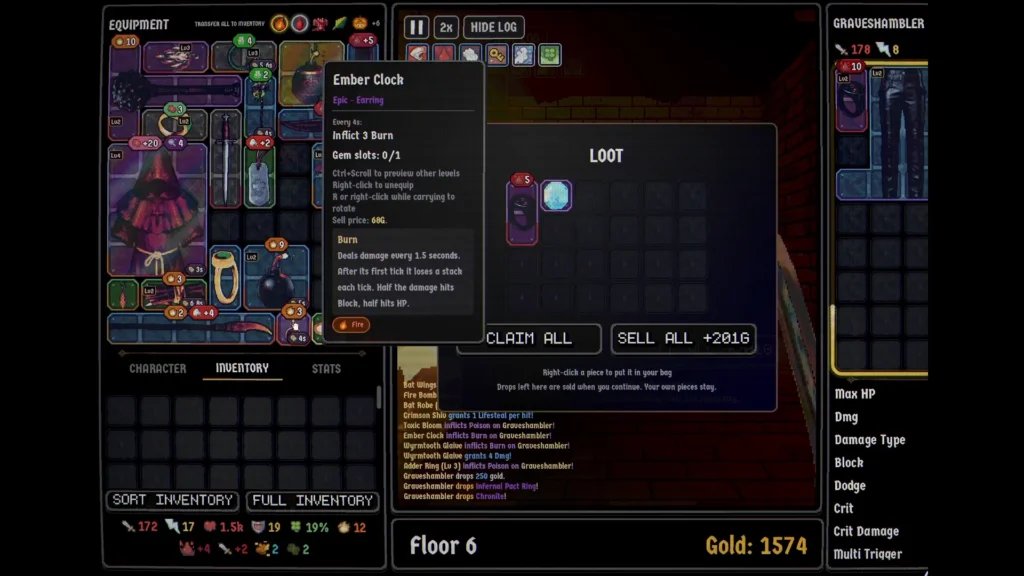
Black Knight has both Fire and Demon affinities. His starting Cinder Blade relic has a chance to apply Burn on hit. His other relic, the Scorched Gauntlet, gave me a timed Burn effect option. That made him a natural choice for a build that I wanted to focus on repeated Burn effects. Any other Fire equipment can help increase the Burn effect (both the intensity and the frequency). Oh and also, Ember Censer became such a better item after the new update: it now applies 3 Burn at battle start without burning its owner.
Valkyrie Lightning Build & Holy Build

Valkyrie is a hero of Lightning and Holy affinity. Valkyrie’s starting relic, Storm’s Favour, granted me a +15% Multi Trigger. That made it so that repeated item activations turned into a blizzard of damage. Storm Coil, her other relic, provided Chain Lightning every five seconds. So her whole shtick was simultaneous damage outputs. And then her Holy equipment can support recovery while Lightning effects provide damage. Best of both worlds.
Ashigaru Wind Build, Metal Build, and Spear Build
Ashigaru is pretty unique in that he has has Wind and Metal affinities, along with the weird but super interesting Spear Drill relic. Spear Drill provides a 50% bonus on top of a spear’s stats. His other starting relic, Ashigaru Yari, gives you +6 Damage and +1 Speed. I’d focus on spear upgrades first though, then from there, I recommend you add equipment that improves Block. Corner Guard is the defensive equipment I recommend because of its corner bonus. Frostbite effects are also super useful if you want more disruption through another method.
Pumpkin Head Build, Haunted Build, and Cursed Build
Pumpkin Head is the hero that provides a fun pathway that lets you experiment with its affinities and the equipment that resonate with them. Specifically, the Haunted equipment and cursed effects. Hexbound Ring is one cool item because its effect benefits both from other cursed equipment and Terrified enemies. Terror and Burn are also cool damage types, while Mega Forge can help compress several pieces into a smaller space. This is more of a high-risk high-reward situation because cursed equipment can lead to hurting the build you are actively creating for it.
Monk, Mage and Other Experimental Builds
Monk is so broken that with the right build, it could go as far as hits above 10 million damage. In The Long Haul, Mage offers Lightning, Frost and Fire subclass directions. Rogue can explore trigger-focused equipment, while Alchemist has additional potion interactions. There’s also room for Rage and Regen combos if you want to mess around with them too.
Best Gems for Different Builds
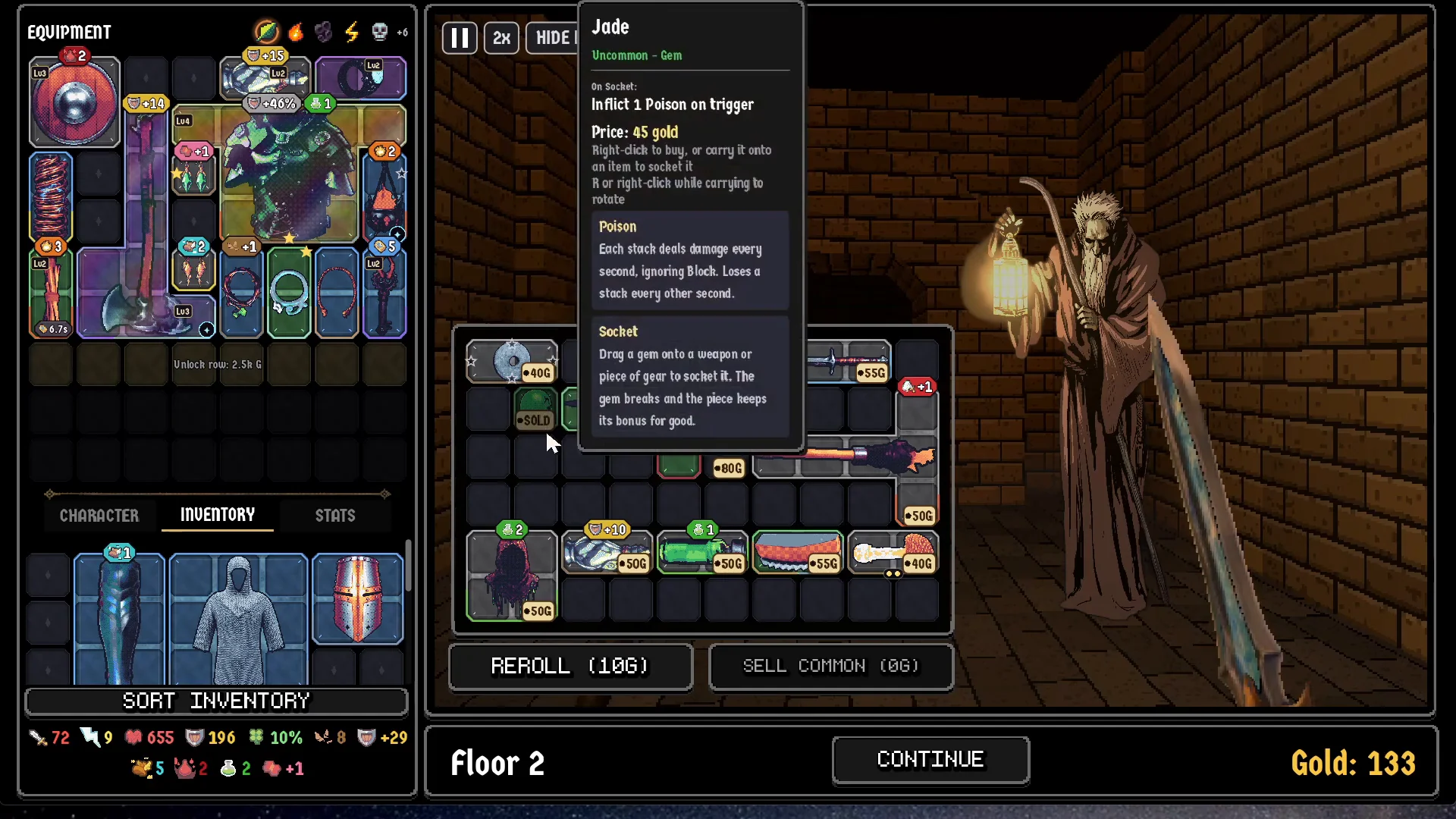
Bloodstone, Jade and Fire Opal are the best flexible gems because they can add status application to equipment. For the Bleed build, go for Bloodstone. For Poison, Jade is the best choice. And if a timed item is what matters to your damage output, Chronite or Hourglass Pearl will provide more value than just some extra Speed. Here’s a list of every Gem you need to know about to amplify your different builds:
| Gem | Build Benefit |
|---|---|
| Bloodstone | Bleed application |
| Jade | Poison application |
| Fire Opal | Burn application |
| Ruby | Damage |
| Emerald | Maximum HP |
| Sapphire | Block |
| Onyx | Thorns |
| Topaz | Critical chance |
| Moonstone | Dodge |
| Citrine | Speed |
| Chronite | Flat cooldown reduction |
| Hourglass Pearl | Percentage cooldown reduction |
| Echo Crystal | Multicast |
Common Dungeonbound Build Mistakes
Rookie mistakes are natural when it comes to games like Dungeonbound, so don’t blame yourself. If you’re still early in the game and want to avoid mistakes that’ll ruin your build, take a close look below on what could go wrong in your run if you aren’t careful. I provided a solution for each problem too.
| Mistake | Solution |
|---|---|
| Filling every inventory cell | Check adjacency and positioning |
| Wasting Rune Cells | Place your main scaling item over the rune |
| Ignoring hero affinity | Consider matching-tag bonuses before swapping equipment |
| Buying equipment for raw stats | Check whether its effects support your build |
| Fusing without checking the preview | Compare the resulting variants and properties |
| Selling useful duplicates | Keep copies that can level your core equipment |
| Stacking Speed for timed items | Use suitable cooldown modifiers |
| Relying only on Block | Add healing or other defensive options |
| Spending everything on rerolls | Reserve Gold for actual equipment purchases |
| Ignoring rival inventories | Examine the interaction that defeated your build |
What’s Changed in Dungeonbound v1.0.14?
The November 22 update introduced several changes relevant to equipment choices. Common weapons received buffs, along with more than 30 items that were rarely selected. Ashigaru received a small buff, as did Relic Hunter and Snuffy. Jeiku and Archer were also improved.
The update introduced Jerry, a new hero who unlocks after defeating 25 Jerrys.
There’s also a new Slot Machine shrine. You can insert a weapon and spin, with three matching results granting a blessing. The status interface is easier to read, and the +N indicator now shows all currently equipped sets.
Is Reaper’s Scythe Actually Good?
Reaper’s Scythe went through some changes that are worth knowing about. In the older versions of the game you’d see a 35% chance to apply Bleed, but patch 0.1.58 changed the weapon so that its Bleed application always occurs when the relevant effect triggers. So yes, it’s actually very good right now, but you don’t have to force it into your build if you don’t want to.