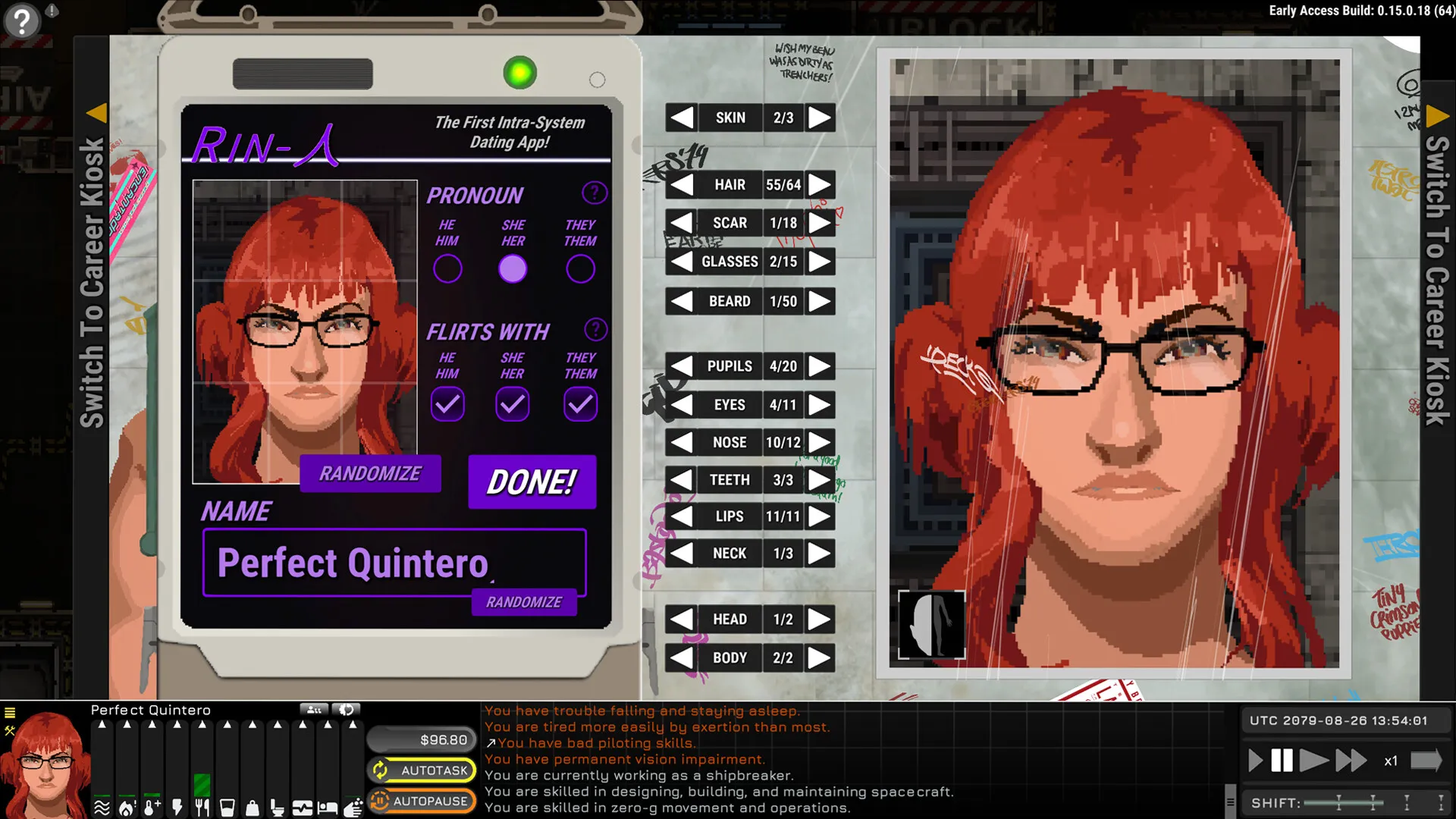


Almost every Ostranauts guide you’ll find was written for build 0.14, before things like combat and bounties existed. As I saw Ostranauts as one of the most underrated trending games in 2026, I made it my mission to change that. This one is built against 1.0 only. Below you can learn about character creation, your first flight, your first salvage run, and why your crew keeps standing around doing nothing.
What You’ll Read:
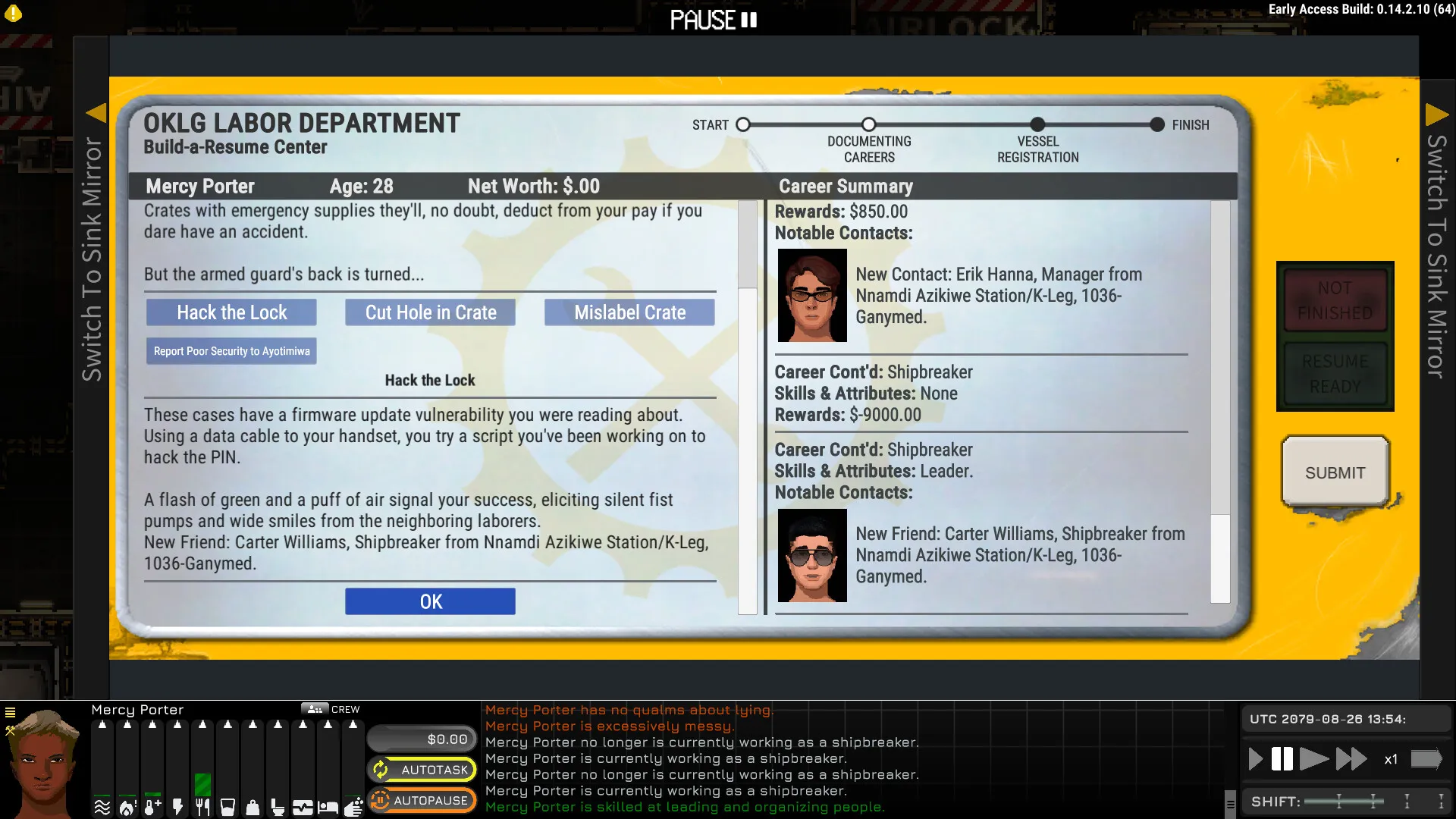
Character Creation Explained
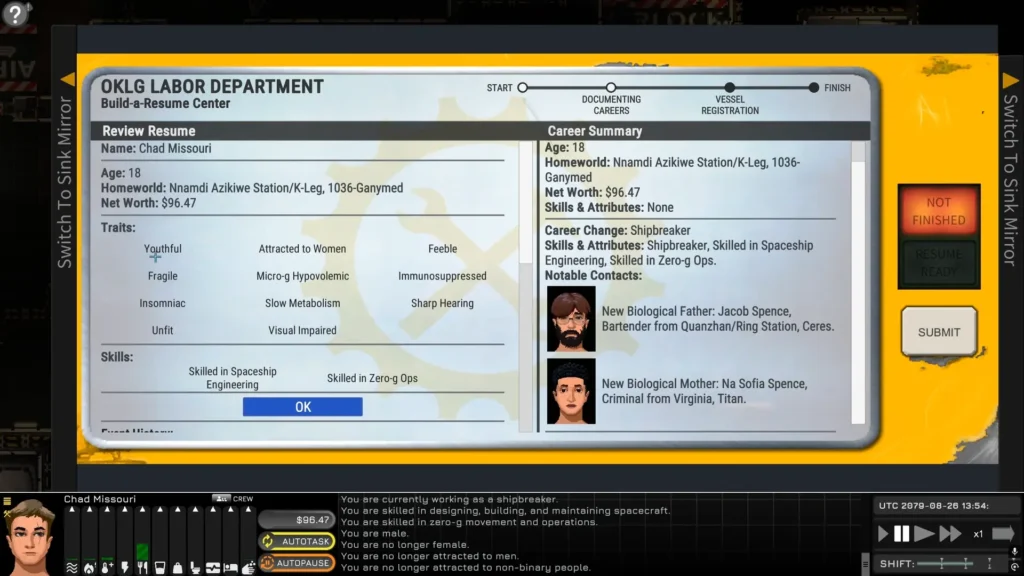
Ostranauts character creation is like a career simulator. You start at 18 years old with a body that grew up in microgravity, meaning weak, fragile, bad eyes and insomnia, plus free skills in Spaceship Engineering and Zero-G Operations. Everything after that costs years off your life. (Life insurance, am I right?)
| Age | What happens |
|---|---|
| 18 | Starting age |
| 29 | Middle-age effects kick in |
| 42 | Old-age effects kick in |
| 47 | Forced to take the first ship offered |
So you get 11 comfortable years and a hard wall at 47. Seek Adventure burns a year on a random narrative encounter and gives the best return here. Save Some Money is a scam; the payout is less than an hour of in-game work.
Choosing Your First Ship
Buy traits over skills, since skills can be learned later and traits can’t. One rule catches everyone: awarded a positive trait while its negative counterpart is active, the game clears the negative first. So you may need to buy the same thing twice.
Mortgage payments hit at the end of every six-hour shift, and a hull without pre-installed life support is cheap for an obvious reason. I wouldn’t chase a “perfect build” though. Trait effects get rebalanced, and the roleplay is half the point.
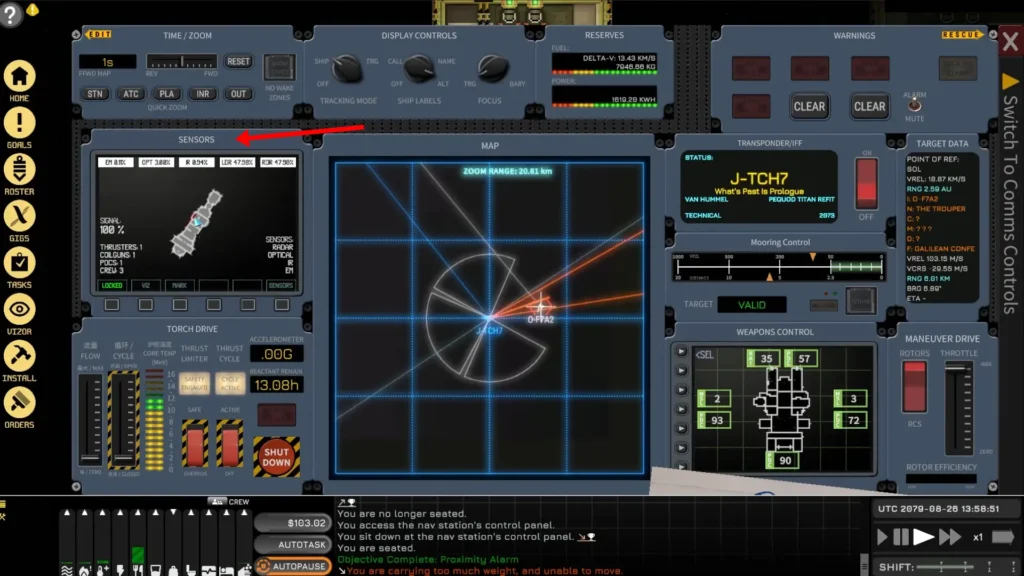
Ship Interface Beginner Guide
Handling your ship interface can be confusing. Here’s how to get it right:
Time, Shifts, Bills
One in-game hour is one real hour at normal speed. Bracket keys adjust speed up to 16x, and the spacebar pauses. A day runs four six-hour shifts plus a short gap called Untime, and mortgage and docking fees hit at the end of every shift. Treat the time bar as a bill countdown.
The Interface
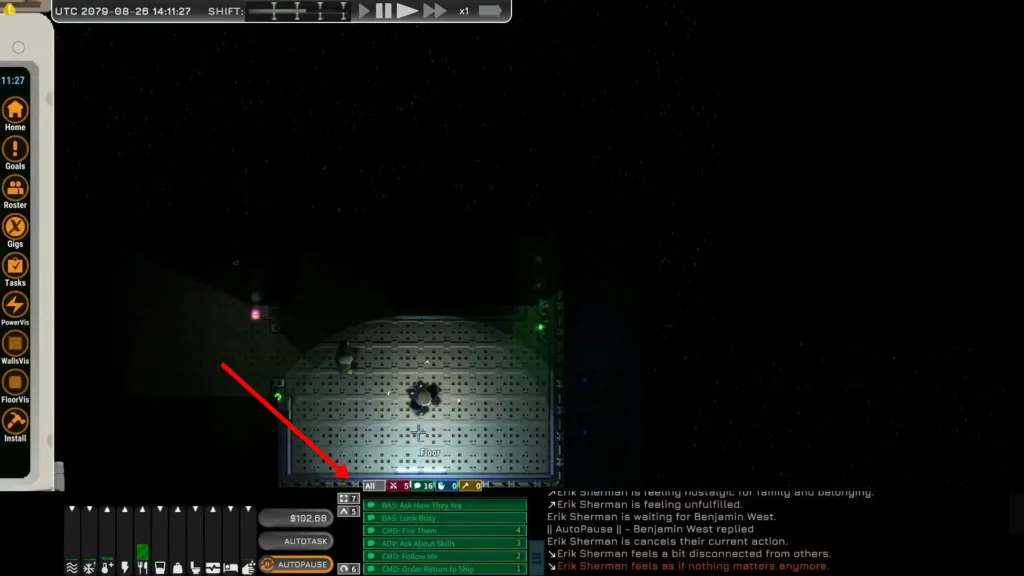
Memorize I for inventory, N for zones, and G to display every gas in the room. The Quick Action Bar on keys 1 through 4 is color coded: red combat, green social, blue object use, yellow building and repair.
On item health bars, green is ordinary wear that labor alone fixes, while red is real damage that stops the item working until you feed it scrap components.
Tools to Buy First
Powered tools need a charged battery, and most batteries only fit their own brand. Here’s the trap nobody warns you about: dump your starting hand tools the moment you own power tools, because the game picks the slow hand tool over the fast one if both sit in your inventory. I lost a full shift to this.
Start with a drill, soldering iron, stir welder, and angle grinder.
Ship Flying and Docking
Flying and docking with your ship has some intricacies that you need to learn to become a pro Ostranauts player. Here are the most important ones:
Before You Undock
Charge your ship batteries. That’s the single most important check, and power capacity is what limits how long you can stay out in the boneyard. A second battery is the standard first upgrade.
Flight also needs a powered transponder and antenna. On COMMS CONTROL: DOCK INFO, REQUEST CLEARANCE, then Request Undocking Clearance, then hit the CLAMPS button.
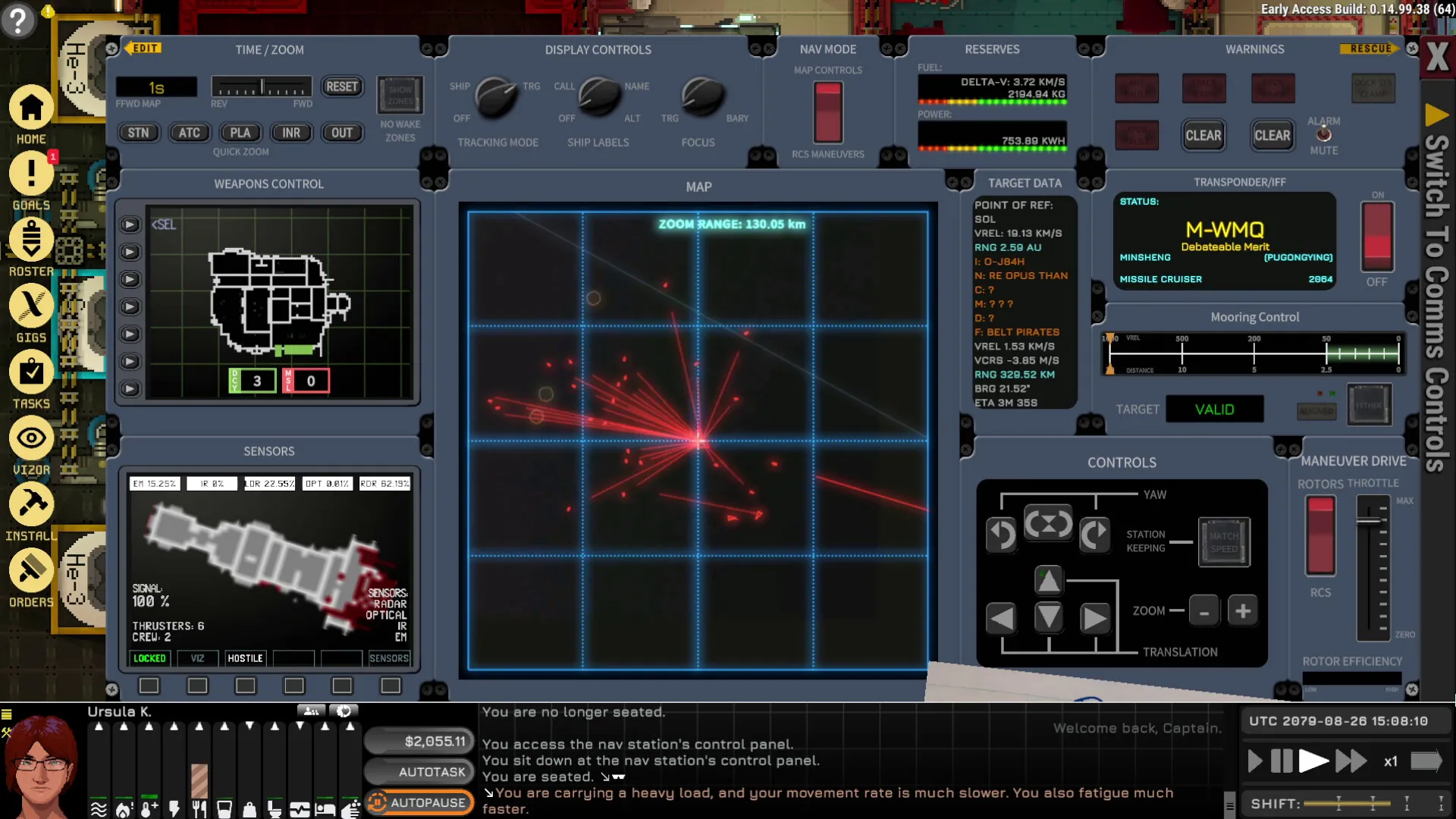
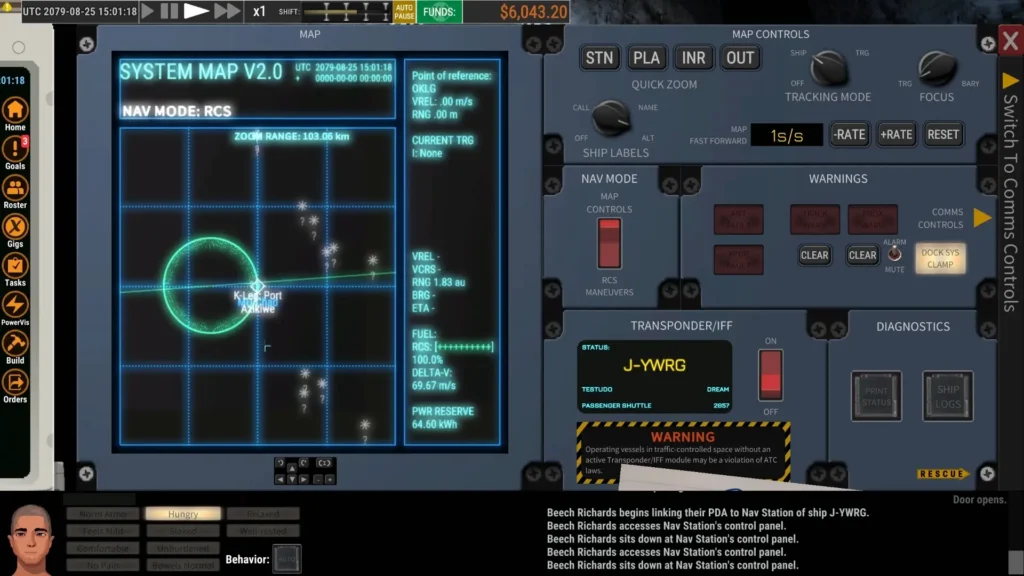
Reading the Nav Console
Nobody explains these abbreviations, and they’re on screen constantly.
| Readout | Meaning |
|---|---|
| VREL | Relative velocity toward or away from your target |
| VCRS | Cross velocity, meaning sideways drift relative to the target |
| RNG | Range to target |
| BRG | Bearing, or relative direction to target |
| Delta-V | Manoeuvring capability you have left |
| ETA | Estimated time of arrival |
This is Newtonian flight, so cutting thrust doesn’t slow you down. Ships handle 3G in an emergency but sit near 1G normally, since blackout starts around 3.5G.
Docking Without Wrecking Your Ship
Older guides tell you to slow to 30 m/s, or below 100 m/s. Ignore the single number. What matters is that both VREL and VCRS sit near zero.
Close within about 5 km, kill both velocities, initiate docking, align the rings, then engage clamps when alignment reads safe. MATCH SPEED on hotkey K doubles as an emergency autopilot.
Your First Salvage Run Walkthrough
Get the permit first. The Ayotimiwa Salvage Permit legalizes shipbreaking and unlocks the licensed kiosk, which pays far better than scrap. It’s tied to your transponder and scannable at range, so NASS security can dock with you and issue a fine. Permits come in five colour-coded tiers at the OKLG kiosk in Port Azikiwe, so ignore any guide quoting one flat price.
Pack a survival kit every run: EVA suit, oxygen, battery, CO2 filter, and a light.
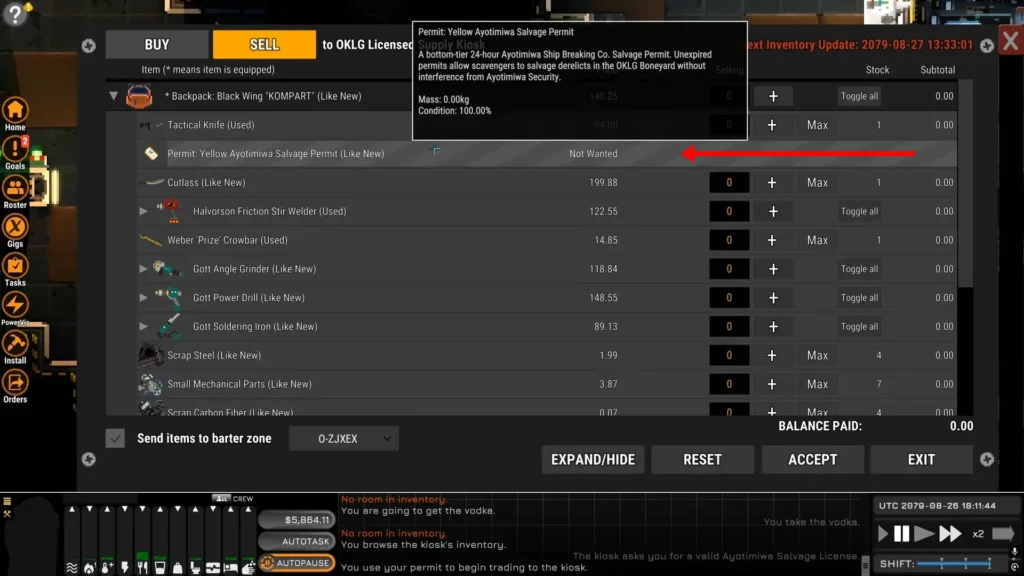
The run itself is four stages: survey the vessel, remove what you want, haul it back, then repair the valuable pieces before selling. Choosing the right removal action is where the money is:
| Action | What it does | When to use it |
|---|---|---|
| Uninstall | Keeps the object intact | Anything you’ll install or sell |
| Dismantle | Careful breakdown for parts | When you need repair components more than the object |
| Scrap | Fast and destructive | Bulk clearing of low-value junk |
| Repair | Restores condition | Before selling anything expensive |
Worn items need labor only; damaged ones need components too, and both sell for less. Every derelict strips completely except the main airlock and docking port.
Managing Crew, Orders, and Zones
Hiring is a social negotiation, not a menu purchase, and the package can include salary, a signing bonus, and death pay. Crew run three shift types, Work, Free, and Sleep, and only pick up queued tasks during Work. Keep duty priorities narrow or they’ll sweep floors instead of repairing your reactor.
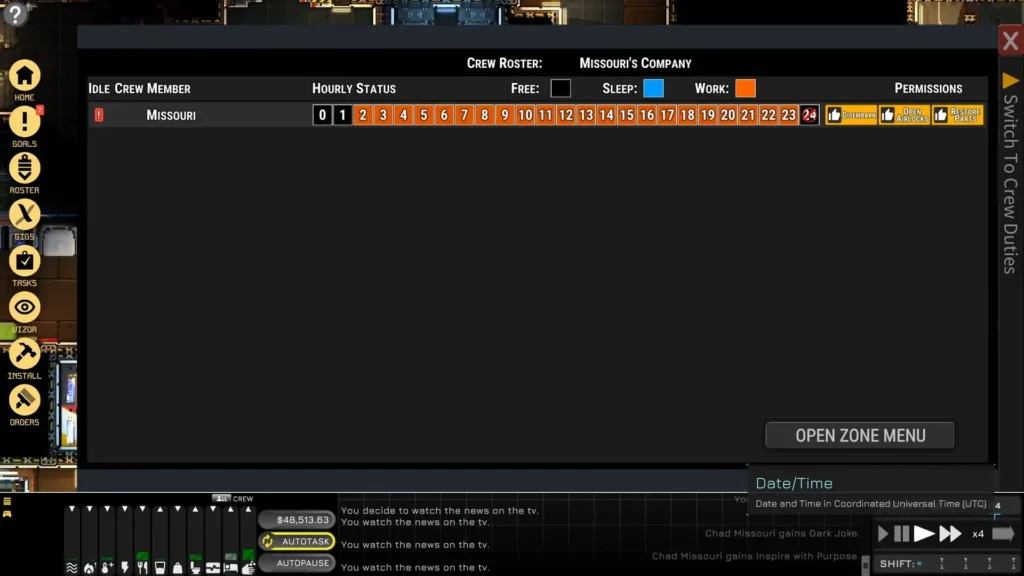
Why Your Crew Is Standing Around
Nine times out of ten it isn’t a bug. Zones decide where hauled items go, what inventory participates in trade, and which areas NPCs can’t enter.
A haul order with no destination zone is incomplete, so the crew member has nowhere valid to put anything and just stands there. That’s the most common cause of idle crew by a wide margin. When someone refuses a task, check the Tasks tooltip for their last failed action, then work through zone type, tiles, ownership, permissions, path, and space.
Money Making Tips and Tricks
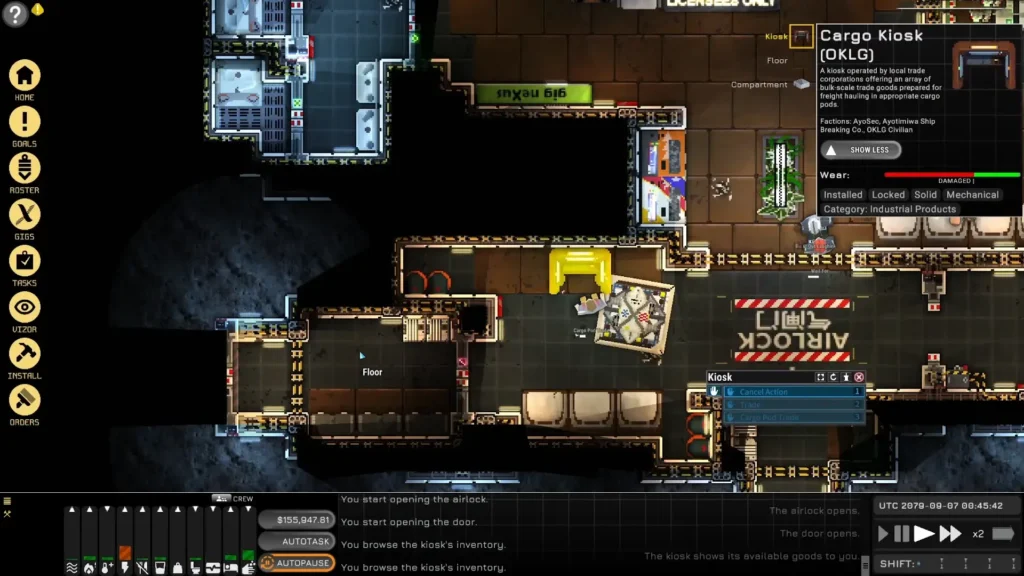
Gigs come from the Gig Nexus job kiosk, and early on only simple courier runs are realistic. Ordinary trading and bulk trading are two separate systems, and mixing them up is the most common player error. Bulk commodities need cargo pods and cargo kiosks, and each pod holds a solid 1,000 kg.
Here’s the quirk worth remembering. Cargo pods sell for roughly 44% less from a zone than carried individually to the kiosk, around $15k versus $27k. Always check the subtotal before confirming.
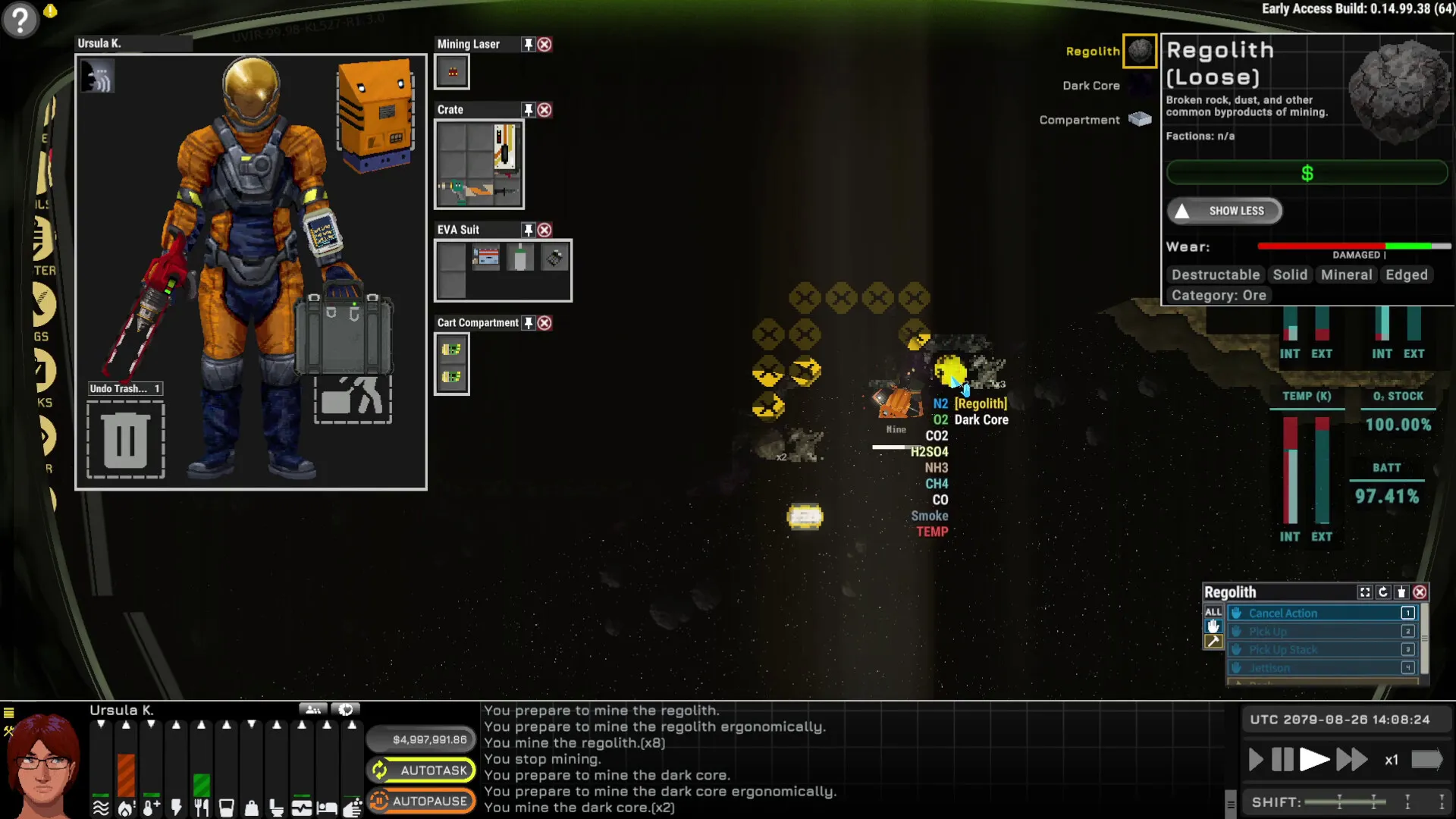
Asteroid mining is a mid-game activity, not a source of income. Since mass costs you fuel, value per kilogram is the number that matters.
| Mineral | Value | Weight | Value per kg |
|---|---|---|---|
| Ore: Platinum | 15,000 | 10 kg | 1,500 |
| Ore: Iridium | 12,000 | 10 kg | 1,200 |
| Ore: Gold | 10,000 | 10 kg | 1,000 |
| Ore: Palladium | 8,000 | 10 kg | 800 |
| Ore: Cobalt | 4,000 | 10 kg | 400 |
| Ore: Wolfram | 2,000 | 10 kg | 200 |
| Gangue Material | 150 | 3 kg | 50 |
| Ore: Silicates | 200 | 10 kg | 20 |
| Meteoric Iron | 250 | 20 kg | 12.5 |
| Regolith | 35 | 20 kg | 1.75 |
Look at gangue. It’s the worthless rock you cut through to reach the good stuff, and per kilogram it beats silicates, meteoric iron, and regolith.
Ship flipping is the quiet one. Converting blank space into recognized room types raises a ship’s price far more than adding hull.
Ship Combat Guide
Combat is opt-in and concentrated around Ceres, so a quiet salvage and trading career is a legitimate way to play the whole game.
If you do go looking, it runs through the navigation station plus your combat modules: detect a contact, get a sensor lock, pick a weapon, then manage range while the other ship responds. Surrender exists on both sides, which almost no guide mentions.
The cheapest useful buy is the Polaris decoy launcher, sold at merely Neutral reputation. The GDM-800 gives 75% success for $25,000 against the GDM-4’s 33% for $5,000, while the GDM-X1 wants $150,000 for the last 25 points.
Bounty hunting is new in 1.0 and lets you bring in criminals dead or alive. The one almost nobody covers is atmospheric racing on Venus.
FAQ
Is Ostranauts still getting updates after 1.0?
Yes. The developers committed to at least one more year of work after launch, and longer if sales allow.
Can I play without ever fighting anyone?
Yes. Fighting is concentrated around Ceres, though your story choices there can shift where it appears.
Do I need crew to make progress?
No. Crew is an efficiency upgrade that matters as your workload grows. A solo captain can run salvage and trade fine.
What if I run out of fuel mid-flight?
Slow down as much as you can, then take PASS to a station and carry a replacement back. Remember this now costs in-game days.
Are old YouTube tutorial series still worth watching?
For flight technique and shipbuilding, yes. Both major series are 0.14-era, so skip them for combat, mining, economy numbers, and the interface.